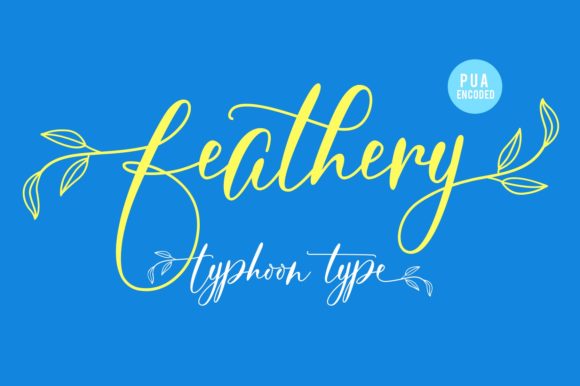
Feathery Font: Delicate Handwritten Elegance for Crafters
If you've ever held a handmade candle, opened a wedding invitation with that quiet hush of reverence, or admired a boutique tag that feels like it was written just for you—you know the power of a truly expressive script font. Feathery isn’t just another handwritten typeface. It’s a delicate, flowing script font from Script Amp that carries an elegant touch—soft yet confident, timeless but never dated. As someone who designs printable wall art, cuts vinyl for farmhouse signs, and hand-illustrates labels for small-batch skincare, I reached for Feathery the moment I saw its subtle rhythm and graceful terminals—and haven’t swapped it out since.
What makes Feathery stand out in my workflow is how it balances beauty with function. Its letterforms are intentionally airy, with gentle contrast between thick and thin strokes and delicate entry/exit strokes that invite the eye without overwhelming it. Unlike some ornate scripts that vanish at small sizes, Feathery maintains legibility down to 14pt on printed cards—and even holds up beautifully when cut at 0.75" tall on Cricut or Silhouette machines for sticker sheets or mini gift tags. That readability matters when your customer is reading “Lavender & Oat Milk” on a soap label—not squinting at tangled loops.
I use Feathery across nearly every physical product I make: wedding welcome boards (paired with a light sans serif for names and times), boutique clothing tags (“Hand-dyed • Small Batch • Made in Portland”), holiday mugs (“Cozy Season”), and seasonal digital printables like planner stickers and printable quote art. For wedding stationery, I layer Feathery for names and headings over clean, open-type sans serifs like Montserrat or Poppins—creating contrast that feels intentional, not chaotic. On product packaging, especially for candles, teas, or bath salts, Feathery adds warmth and artisanal credibility without leaning into cutesy or overly formal territory.
It shines brightest in display contexts: short phrases, titles, monograms, and decorative accents. Think “Gather,” “Hello, Love,” or “Est. 2023” on a wooden sign—or “The Perfect Blend” arcing gently over a coffee bag design. Because Feathery is a premium font built for real-world production, it includes OpenType features like contextual alternates and optional swashes—so you can swap in a more ornamental “&” or add a graceful flourish to the end of “With Love” without manual vector editing. The included .OTF and .TTF files install cleanly on both Mac and Windows, and work flawlessly in Canva, Adobe Illustrator, Cricut Design Space, and Silhouette Studio.
For crafters using Feathery in commercial projects—whether selling SVG files on Etsy, bundling editable templates, printing custom tote bags, or designing client-branded packaging—it’s essential to confirm licensing. Feathery comes with a commercial license that covers physical products, digital downloads, social media graphics, and client work—no need to track impressions or purchase extended rights for standard small-business use. That peace of mind lets me focus on design, not legal footnotes.
Readability tips I’ve learned the hard way: avoid stacking Feathery in all-caps for longer text—it’s designed as a title and accent font, not body copy. For candle jar labels with multiple lines, I use Feathery only for the scent name (“Sage + Sea Salt”) and switch to a crisp, low-contrast sans serif for ingredients and net weight. On dark backgrounds, I slightly increase letter spacing (tracking) in Illustrator to prevent visual crowding. And when prepping for print, I always convert Feathery to outlines before sending to my local printer—just in case their system doesn’t have the font installed.
Pairing Feathery thoughtfully elevates everything. My go-to combinations? A warm, humanist sans serif like Quicksand or Nunito for contrast and clarity—especially in multi-element layouts like greeting cards or shop signage. For vintage-inspired packaging, I’ll pair Feathery with a soft serif like Playfair Display (light weight) to anchor headings while letting Feathery dance above product names. If you're designing social media banners or Instagram story templates, Feathery works beautifully over textured backgrounds—its fine hairlines catch light just enough to feel tactile, even digitally.
It’s also become my secret weapon for seasonal craft collections. Last fall, I used Feathery’s swash “g” and looping “y” to create “Harvest Days” wall art that sold out in 48 hours. For spring, I paired it with botanical line art and printed it on kraft paper tags for potted herb kits—customers specifically mentioned how “handwritten and heartfelt” the typography felt. Even on merchandise like linen tea towels or ceramic mugs, Feathery translates well: its curves soften sharp edges, and its elegance reads as intentional craftsmanship—not generic clipart.
As a small shop owner who depends on repeat buyers and word-of-mouth referrals, I’ve noticed something subtle but powerful: customers associate Feathery’s tone with care. When they see it on a thank-you card tucked inside a package, or on a reusable shopping bag, it signals attention to detail—not just in the product, but in how it’s presented. That emotional resonance builds brand consistency across touchpoints: your website banner, your Instagram highlight covers, your printed receipt tape, and your product labels all feel like part of one thoughtful world.
Feathery isn’t flashy—but it’s unforgettable. It doesn’t shout; it lingers. Whether you’re cutting vinyl for a local farmer’s market booth, designing digital party invites, or branding a new line of organic skincare, this script font delivers quiet sophistication that sells itself. It’s the kind of typeface that makes people pause, smile, and say, “Who designed this?”—which, for any maker building a recognizable, beloved brand, is exactly the reaction you want.